If you’ve ever crossed the Burnside Bridge into downtown Portland at night, you’ve seen it: a glowing sometimes red-nosed deer leaping over the words “PORTLAND OREGON,” perched on top of a squat brick building in Old Town. It’s one of those landmarks that stops registering as a sign after a while and starts feeling more like a fixture of the skyline itself — something that was always there. But the sign has changed its identity at least four times, and its survival was never a sure thing.
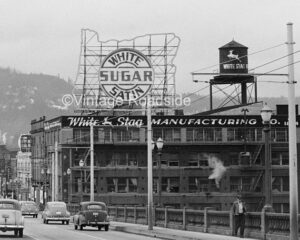
The story starts in 1940, when a local company called Ramsay Signs built a massive 50-by-52-foot sign for the roof of the Hirsch-Weis building at 70 NW Couch Street. Back then, it wasn’t advertising sportswear or the city — it was promoting White Satin Sugar, and the design was a lit outline of the state of Oregon with the product name glowing inside it. A decade later, in 1950, the design was updated so the outline of the state appeared to “fill” with sugar, a nice bit of visual flair for the era.
The sign didn’t get its now-famous deer until 1957. The building’s occupant, Hirsch-Weis, had spun off a sportswear line called White Stag, and the company put its own branding on the roof: a leaping white stag silhouette above the words “White Stag Sportswear.” The idea to give the deer a red neon nose came two years later, in 1959, suggested by Elizabeth Hirsch, wife of company head Harold Hirsch — a small holiday gesture that turned into the sign’s most beloved feature. Every year since (with the sign lit), the nose glows red starting the day before Thanksgiving, turning the stag into Portland’s own Rudolph for the season.
By the mid-1970s, the sign had become so tied to the city’s identity, especially around Christmas, that the City of Portland designated it a historic landmark in 1977. That designation protected the design of the sign, but notably didn’t freeze its wording in place — a distinction that would matter later.
White Stag itself didn’t stay put. The company moved out of the building in 1973, though it kept paying to light and maintain the sign for years afterward as a kind of goodwill gesture. That arrangement finally ran out in 1986, when White Stag left Oregon for good. Warnaco, the company’s parent at the time, kept the lights on until May 1989, when the sign went dark.
The building’s owner, Bill Naito, stepped in to keep the tradition alive, paying for the sign to be lit during the Christmas season even while it wasn’t otherwise operating. After Naito’s death in 1996, a dispute broke out over who should cover repairs — resolved with help from then-mayor Vera Katz. The outcome, in 1997, was a new identity for the sign: “Made in Oregon,” promoting the Naito family’s Oregon gift-shop brand, with “Old Town” replacing “Sportswear” along the bottom. The stag stayed exactly where it was.
The sign’s closest brush with real controversy came in 2008, when the University of Oregon leased space in the building for a Portland campus and wanted to change the lettering to read “University of Oregon.” Portlanders were having none of it. According to Ramsay Signs owner Joe Gibson, the backlash became one of the biggest local social media firestorms the city had seen at that point — people weren’t willing to let an out-of-town university brand their skyline.
The city took notice. Led by then-commissioner Randy Leonard, Portland moved to take ownership of the sign outright. Ramsay Signs, which had owned it since 1940, formally donated it to the city in September 2010. The building’s owner, Venerable Properties, paid roughly $200,000 to have the lettering changed one final time — to the simple, civic-minded “PORTLAND OREGON” it wears today.
The sign has picked up a bit of hardware since then, too: Ramsay Signs won first place in the Historic Reproduction category of an International Sign Association design competition in 2011 for its work reproducing the sign’s hand-lettered style. And every year, the city still marks the unofficial start of the holiday season by lighting that red nose the day before Thanksgiving — a tradition now well into its seventh decade.
What’s remarkable, looking back, is how much the sign’s purpose has shifted while its shape has barely moved. A sugar ad became a clothing ad became a gift-shop ad became, finally, no ad at all — just the city’s name, glowing over the river, for its own sake. Not many pieces of commercial signage get to retire into being a civic symbol. This one did.
Next time you’re heading into Old Town over the Burnside Bridge, look up. That stag has been leaping over that same rooftop since Eisenhower was in office — even if the words underneath it have never quite stayed the same.