Here’s a little secret that trips up a lot of people: not every “neon sign” actually contains neon. The name stuck because neon was the gas that started it all, but the glowing tubes bent into cursive diner names and glowing martini glasses draw from a small family of noble gases, each with its own personality, quirks, and signature glow. Understanding what’s actually inside the glass is understanding why a sign looks the way it does.
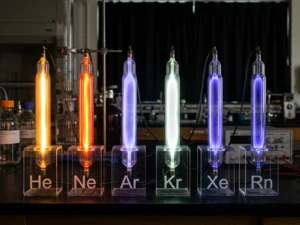
Pure neon gas is where the whole medium gets its name, and it’s still the go-to for a reason. Run current through it and you get a bold, saturated red-orange — the color most people picture when they hear “neon sign.” It’s a forgiving gas to work with, too: neon is a natural (if trace) component of the air we breathe, so it’s cheap to isolate and purify, and only a small amount is needed to fill a tube. It also holds up well in the cold, which is part of why classic red neon has always been a favorite for outdoor signage in places that get real winters.
If neon is the star, argon is the versatile character actor. On its own, argon puts out a comparatively faint blue or lavender light — enough to notice, not enough to make a statement. What makes argon so central to sign-making isn’t its solo performance, though; it’s what happens when you add a trace of mercury vapor to the tube. That combination produces a much stronger, brighter light, typically a soft blue, and it becomes the base for a huge range of other colors once you introduce colored glass tubing or interior phosphor coatings. Green, yellow, white — a lot of that comes from argon-mercury tubes paired with the right glass or coating, not from a different noble gas entirely.
The tradeoff: argon-mercury tubes can get sluggish in cold weather, sometimes dimming or flickering below about 45°F, which is one reason old-school red neon signs remained the more reliable choice for harsh outdoor climates.
Mercury vapor rarely works alone in a sign — its role is almost always supporting. A small amount added to argon boosts brightness and shifts the color toward blue or white, and the ultraviolet light mercury emits is also what makes phosphor-coated tubes glow with colors the raw gas mixture couldn’t produce by itself. It’s an effective tool, but it’s also the one gas on this list worth handling with real caution: if a mercury-containing tube breaks, the vapor can be genuinely harmful to inhale, which is part of why the sign industry has moved toward reducing or eliminating mercury where possible.
Pure helium produces a pinkish-red glow, distinct enough from neon’s red-orange that a trained eye can tell them apart. It doesn’t see much use as a standalone fill gas, though — helium is genuinely scarce as an industrial resource, since most of what’s harvested comes from natural gas deposits or radioactive decay rather than the atmosphere. Where helium does show up often is as an additive: mixed into cold-climate argon tubes, it helps the gas heat up and strike its glow more quickly, making sign start-up more reliable in low temperatures.
Krypton produces a soft, pale glow, often described as whitish-yellow or faintly blue-white, that’s less about vivid drama and more about a specific, muted tone. Because that base glow is so understated, krypton tubes lean heavily on colored glass to land on their final hue. It’s not the gas you’ll find in a lot of loud storefront signage, but it has real staying power in more specialized applications — including, notably, airport runway lighting, where its distinct and reliable output matters more than showmanship.
Xenon rounds out the family with a deep lavender-to-blue glow, and like helium, it doesn’t get used solo in signage very often. Its bigger claim to fame is outside the sign shop entirely, in strobe lights and photographic flash equipment, where its particular light-emission properties are prized. Within neon work, xenon tends to show up blended with other noble gases to produce color combinations that would be hard to reach otherwise — a specialty tool for high-end or unusual displays rather than an everyday fill.
None of these gases work in a vacuum — figuratively or, well, almost literally. The final color of any given tube comes from a layered set of decisions: which noble gas (or gas mixture) fills it, whether mercury is present, what the glass tubing itself is tinted, and whether the interior is coated in fluorescent phosphors that the gas’s output excites into a different color entirely. Two tubes filled with the exact same gas can look completely different depending on the glass and coating choices around them.
It’s a reminder that neon signage, for all its old-fashioned charm, is genuinely a piece of applied chemistry and physics — noble gases chosen for their chemical stability, electrons excited into higher energy states, and that energy released as visible light the moment they settle back down. The next time you’re walking past a glowing storefront window, it’s worth remembering that the warm red script and the cool blue accent beside it probably aren’t even made of the same stuff.