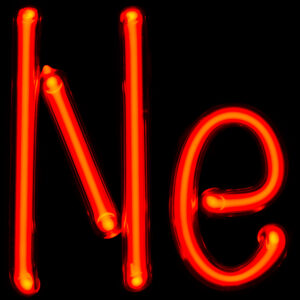
Walk down almost any city street after dark and you’ll likely see it: that unmistakable warm glow spilling out of glass tubing, bending into letters and shapes that seem to hum with their own kind of electricity. Neon signs have become so woven into our visual culture that we rarely stop to ask where they came from, how they actually work, or why a gas most people can’t even name became one of the twentieth century’s most iconic design materials. The story turns out to be a surprisingly rich one, running through French physics labs, American car dealerships, Times Square spectacles, and the desert glow of Las Vegas.
The story begins not with signage but with basic chemistry. In 1898, two British scientists, William Ramsay and Morris Travers, were working at University College London on a project to isolate and identify the gases present in the atmosphere. They had already discovered argon a couple of years earlier, and their meticulous work with liquefied air led them to isolate several previously unknown elements in rapid succession: krypton, neon, and xenon all emerged from their experiments within the span of a few weeks.
Neon was named from the Greek word “neos,” meaning “new.” It’s an inert, colorless gas that makes up only a tiny fraction of Earth’s atmosphere — about 18 parts per million. On its own, sitting in a jar, neon does nothing remarkable at all. It took another set of experiments, and another few years, before anyone realized what happened when you ran an electrical current through it.
Ramsay and Travers noticed that when neon gas was placed inside a vacuum tube and electrified, it produced a brilliant red-orange glow unlike anything they had seen from other gases. It was a striking effect, but at the time it was treated as a scientific curiosity rather than the seed of a global industry.
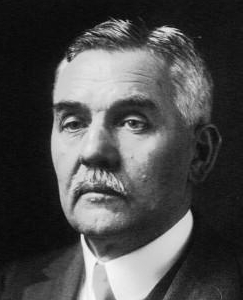
Georges Claude 1926
The person most responsible for turning that laboratory curiosity into a commercial technology was a French engineer and chemist named Georges Claude. Claude had built asuccessful business liquefying air on an industrial scale, which incidentally produced neon as a byproduct that had previously gone to waste. Recognizing an opportunity, he began experimenting with sealing neon gas inside glass tubes and running current through them to produce light.
Claude didn’t just rediscover the glow that Ramsay and Travers had observed — he solved the practical problems that stood between a lab effect and a usable light source. He developed methods for producing neon in large quantities, created electrodes that could withstand the corrosive effects of the gas discharge over time, and figured out how to bend glass tubing into custom shapes while keeping it airtight. He patented his neon tube design in 1910 and unveiled it publicly at the Paris Motor Show that same year, illuminating the building with two long red neon tubes.
By 1912, Claude had gone a step further, applying his tubes to advertising. He installed what is generally considered the first neon sign for a Paris barbershop, and within a few years, neon signage began appearing on buildings and storefronts across Paris. Claude and his company, Claude Neon, aggressively patented the technology and licensed it internationally, which meant that for years, anyone who wanted to produce neon signs commercially had to pay Claude Neon for the privilege.
Neon signage made its American debut in 1923, when a Los Angeles Packard car dealership owned by Earle C. Anthony purchased two neon signs from Claude’s French company for a jaw-dropping sum — reportedly around $24,000, an enormous amount of money for the era. The signs, reading “Packard,” stopped traffic. People pulled over just to look at them. Newspapers described the glowing red script as “liquid fire,” and the spectacle alone was said to have been worth the investment in publicity many times over.
That kind of reaction — pure astonishment at a technology nobody had seen before — set the tone for neon’s rapid spread through American commercial culture over the following decade. Business owners recognized that neon signs did something no other form of lighting could: they were visible day and night, they could be shaped into virtually any word or image, and they carried a futuristic, almost magical quality that instantly separated a business from its neighbors. By the late 1920s and into the 1930s, neon signage had become a fixture of American cities, illuminating movie theaters, diners, motels, gas stations, and nightclubs.
Part of what makes neon such a compelling design material is the underlying physics, which is worth understanding to appreciate why these signs look the way they do. A neon tube is a sealed glass tube with electrodes at each end, filled with a small amount of gas at low pressure. When high voltage is applied across the electrodes, it ionizes the gas inside, stripping electrons from the gas atoms and creating a plasma. As those electrons recombine with the atoms, they release energy in the form of light, and the specific color depends on which gas is used.
Pure neon gas produces that classic red-orange glow. Other colors are achieved either by using different noble gases — argon typically produces a pale blue or lavender light — or by coating the inside of the glass tube with fluorescent phosphors that convert the emitted light into different colors, or by using colored glass tubing itself. Skilled tube benders, historically called “glass benders” or “tube benders,” heat the glass over a flame and shape it by hand into letters, curves, and images, which is why traditional neon signage has such a distinctly organic, handcrafted quality compared to later LED alternatives.
The 1930s through the 1950s are often considered the golden age of neon signage in the United States. Times Square in New York became a dazzling showcase of animated, multi-colored neon spectacles advertising everything from cigarettes to soft drinks, with signs growing larger and more elaborate as businesses competed for attention. Route 66 and America’s growing car culture fueled a boom in neon-lit motels, diners, and gas stations designed to catch the eye of drivers speeding past at highway speeds.
Perhaps nowhere did neon find a more natural home than in Las Vegas. As the city built its identity around casinos and nightlife in the mid-twentieth century, neon signage became central to its visual language. Enormous, elaborately designed signs for casinos and hotels turned the Las Vegas Strip and its downtown Fremont Street into round-the-clock displays of glowing color, and neon became inseparable from the city’s brand. Today, Las Vegas is home to the Neon Museum, an outdoor collection dedicated to preserving and displaying retired signs from the city’s casino history, a testament to how central this technology became to a particular vision of mid-century American glamour.
Neon’s dominance didn’t last forever. Starting in the 1960s and accelerating through subsequent decades, cheaper plastic and internally lit signage began displacing neon in much everyday commercial use. Neon tubes are labor-intensive to produce, require skilled glassworkers, are relatively fragile, and consume more maintenance than newer lighting technologies. By the late twentieth century, LED signage had emerged as a serious competitor, offering lower energy consumption, easier mass production, and greater durability, and it gradually became the default choice for most commercial signage.
Yet neon never disappeared, and in recent decades it has enjoyed something of a cultural revival. Artists, designers, and business owners drawn to its warm, handcrafted glow and nostalgic associations have kept the craft alive, and neon has found new life in art installations, custom home decor, and boutique branding that trades on retro appeal. Cities like Las Vegas and cultural institutions elsewhere have made deliberate efforts to preserve historic neon signage as a form of public art and heritage, recognizing that these glowing tubes capture something about mid-century optimism and showmanship that newer technologies, for all their efficiency, simply don’t replicate.
More than a century after Ramsay and Travers first isolated neon gas, and more than a hundred years since Georges Claude bent it into glowing tubes over a Paris barbershop, neon signage remains a recognizable, evocative piece of visual history. It marks a moment when a simple noble gas, discovered almost by accident, became a canvas for commerce, art, and civic identity. Whether flickering above a diner, spelling out a casino’s name across the desert sky, or glowing in a gallery installation, neon still carries the same sense of wonder that stopped traffic outside that Los Angeles Packard dealership back in 1923 — proof that sometimes the most enduring technologies are also the most beautiful ones.